
Strengthening Digital Agricultural Advisory: Reflections from Uganda’s AgriPath Toolkit Validation Workshop
12/02/2025
Authors: Lakshmi Iyer & Bobbi Gray
In October 2025, AgriPath convened its first digital agricultural advisory services (DAS) toolkit validation workshop in Kampala, Uganda with members of the National Steering Committee (NSC). Kilimo Trust, AgriPath’s implementing partner in Uganda and Tanzania, hosted the workshop. This one-day facilitated session was designed to present and validate the DAS toolkit, with a specific focus on the business model tools for DAS providers.
The workshop brought together critical public and private actors within Uganda’s digital agriculture ecosystem to exchange insights, test the relevance of the DAS toolkit, and collectively identify areas for strengthening impact for smallholder farmers.
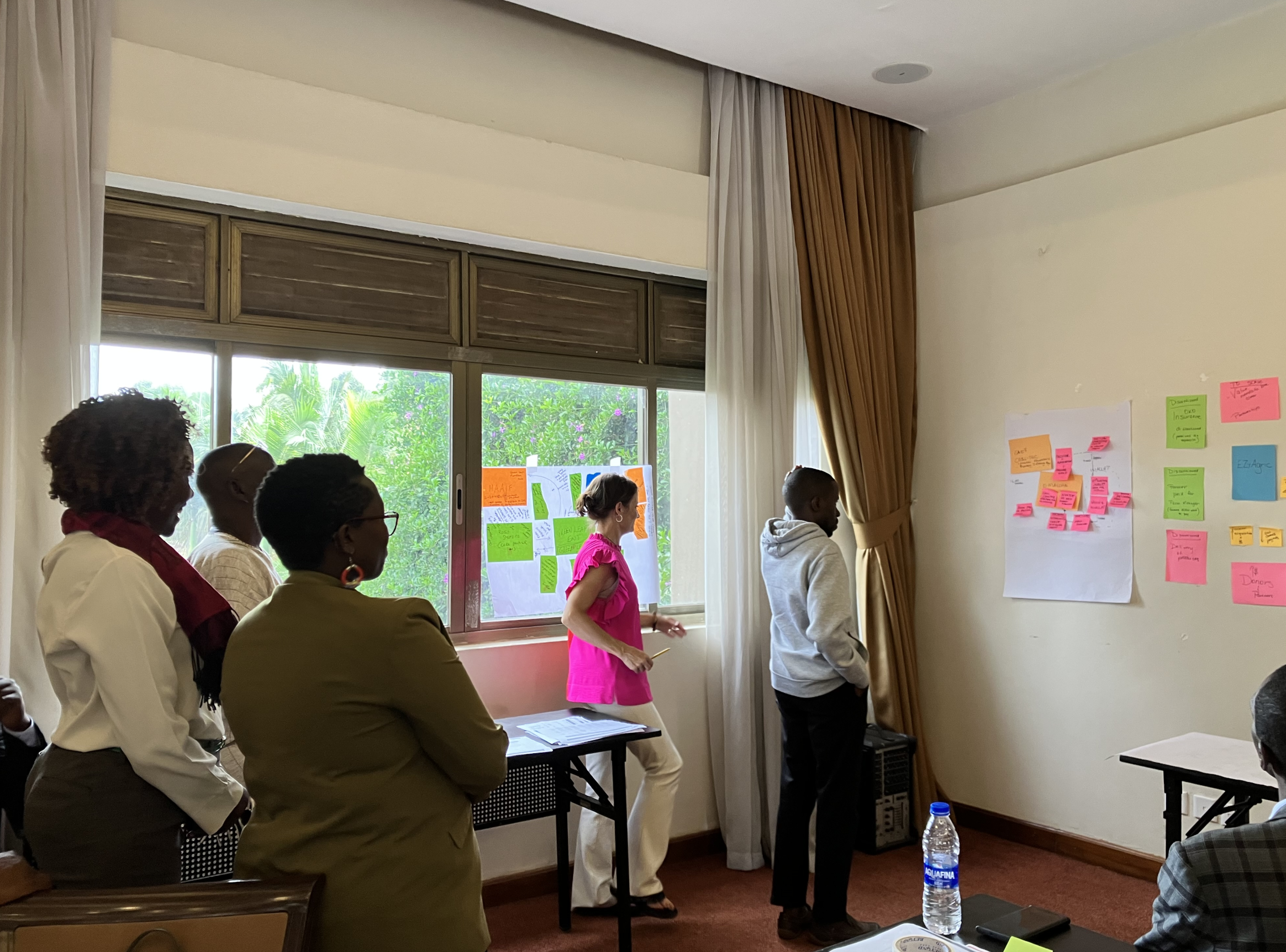
DAS toolkit workshop that brought together critical public and private actors within Uganda’s digital agriculture ecosystem to exchange insights, test the relevance of the DAS toolkit, and collectively identify areas for strengthening impact for smallholder farmers.
What is the DAS Toolkit?
The DAS toolkit is a resource designed by AgriPath to equip DAS stakeholders, particularly those seeking to scale smartphone-based DAS, with practical and research-based tools to strengthen extension agent networks and deliver scalable, sustainable DAS for smallholder farmers, especially women. AgriPath’s five-year research suggests that in order to effectively scale DAS for smallholder farmers, community-based agents (CBAs) are required to bridge the gap between digital tools and farmer knowledge and adoption of sustainable land management practices.
Practical Insights from DAS Providers
During the session, DAS providers reviewed the business model tools and reflected on their usefulness and applicability to existing and emerging DAS. DAS provider business models are one of the most salient aspects of being able to survive, thrive and scale as an enterprise generating impact for smallholder farmers.
The feedback from DAS providers highlighted the real-world challenges and learning curves of building viable businesses. These reflections underscored that the DAS toolkit offers practical, experience-based guidance, especially for early-stage DAS providers who often learn through trial and error.
“When we first began our digital service for farmers, I thought that just someone downloading the app was enough. I was not thinking about farmers actually using the app. This toolkit is extremely necessary for new DAS providers to not have to go through this learned cycle all over again.” – Zilla Mary Arach, NSC Member, EZyAgric
“You have generated something I should have generated myself for my own DAS business – thank you!” — Humphrey Mutaasa, NSC Member and DAS Provider (Grain Council of Uganda)
At the same time, the discussion brought to light deeper questions about farmer engagement and digital behavior. Some participants noted that not all smartphone users are potential app users for agriculture: “Perhaps for some, a smartphone is mainly used for one application, like YouTube, or even a status symbol. Getting them to use it for agricultural extension will take more than just an app.” AgriPath’s research echoes this comment in that there is a clear need to understand behavioral insights and localize engagement strategies such as leveraging the strength of CBAs to complement digital tools for effectiveness and farmer adoptions of practices.
Rethinking the Role and Cost of Community-Based Agents
While all participants in the room that day acknowledged the importance of CBAs, the DAS providers also raised cost-benefit concerns for their businesses:
How can digital providers sustainably integrate CBAs into their business models? They need a wage and require transportation costs and funds for mobile data. This entails a heavy boots-on-the-ground financial model if CBAs need to be involved.
How do we retain trained CBAs? For example, there have been cases where recruited, hired and trained CBAs leave (with their farmer networks) after a few years of employment with any DAS provider. Typically CBAs are from the community they work within, and once trained by their employer, they become attractive personnel to any DAS provider trying to engage the same groups of farmers.
Some providers, like EZyAgric, shared innovative approaches to mitigate a few of these challenges such as partnering with local implementers who have their own farmer networks and CBAs, delegating onboarding of farmers and data capture to these implementers who incentivize their CBAs for ongoing farmer support. Meanwhile, public extension representatives suggested that government extension agents could also be leveraged, and could train CBAs as a second-tier cadre rather than having CBAs working in isolation. This exchange revealed that innovative partnership models could strengthen how CBAs are leveraged, and that partnership as an enabler is a critical lever to scaling DAS in inclusive and cost-effective ways. AgriPath’s scaling framework equally suggests that partnerships within an enabling ecosystem is a key enabler in scaling DAS.
Bridging Public and Private Extension: A Shared Vision
A significant outcome of the workshop was the emerging consensus between public and private extension providers on the need to work more collaboratively. DAS providers shared that they initially sought to use public sector data to avoid repeatedly collecting farmer information, both to save costs and reduce farmer fatigue. However, tensions arose when government agents on the ground, and in the vicinity of the CBAs began indirectly monitoring them, eroding trust.
The discussion ultimately converged on a shared understanding:
The public sector could strengthen its role by providing accessible farmer data, standardized good agricultural practices, and user-friendly extension materials.
The private sector could leverage these resources to enhance the reach and relevance of their services.
This collaborative vision, where public extension agents are not left behind in the digital transformation, was a great starting point to delve further into this domain. Many public agents expressed a desire to participate actively in the digital and AI-driven swift changes taking place across agricultural extension for farmers globally and especially in their country, instead of being sidelined by it.
Embedding Collaboration into the Toolkit
AgriPath’s mission is to ensure that digitalization in agriculture strengthens, and does not replace, the human networks that make sustainable agricultural transformation possible. As one participant noted, “This toolkit shows us that public agents are still needed, but it’s about working together differently.”
The valuable feedback from Uganda’s NSC will inform the refinement of the DAS toolkit to include a new section on case studies and a nuanced ‘how to’ section to explain how public agricultural extension department and government agricultural extension agents as well as private DAS providers could find mutually beneficial ways to work together and strengthen impact on smallholder farmers.