
Adopting Sustainable Land Management Practices as a Means of Strengthening Farmers' Resilience
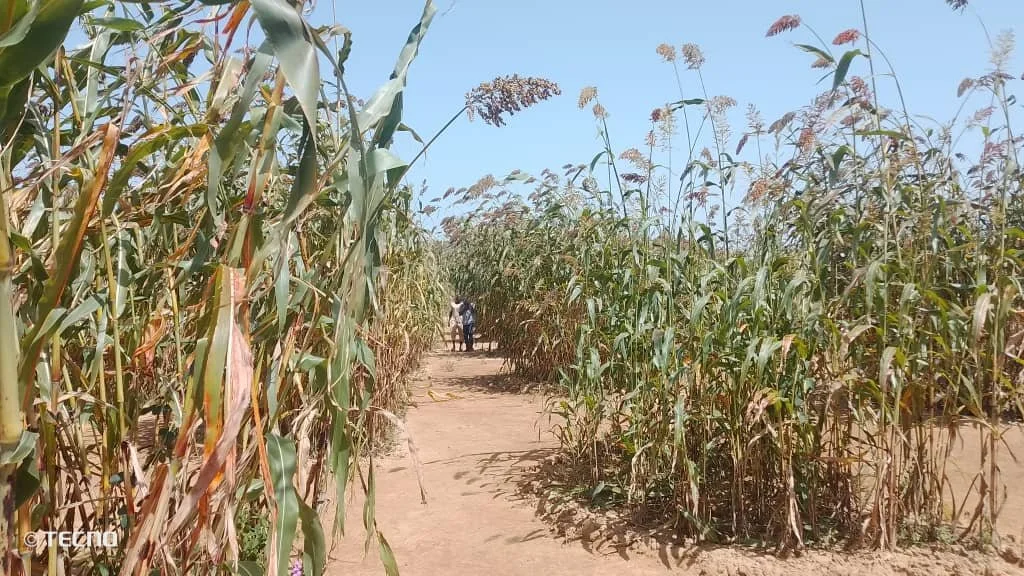
Cultivated land with the half-moon technique in Burkina Faso.
12/02/2025
Zi Noraogo is a farmer from the village of Koalla in the Passoré Province of Burkina Faso, where the AgriPath Project connects him as well as several other farmers to selected, trusted community-based agents (CBAs) with the goal of scaling digital agricultural advisory services (DAS) for better sustainable land management (SLM). CBAs play an essential role in supporting farmers by providing training and guidance on how to better apply context-specific practices to improve the yields of their fields and connect to markets.
Farmers have been receptive to AgriPath’s intervention, opening their fields to new ways of farming the land. The area – a Sahelian zone with degraded soils – is now being transformed through training and guidance on practices related to rainwater conservation, water retention capacity, and soil fertility. Without these SLM practices, it would be virtually impossible to successfully cultivate land in Passoré.
The farmers are using the farmbetter app – specifically chosen for the project due to its unique features including over 1,200 SLM practices recommendations for various contexts. They are particularly drawn to seven practices – the use of organic fertilizer, half-moons, zaï, stone rows, intercropping (mixing cereals with legumes), crop rotation, and grass strips – as these methods are known to restore degraded land through soil and water conservation.
Furthermore, Zi Noraogo has greatly benefited through the support of Somma Wendyida, one of the CBAs who is highly dedicated and committed to the farmers and their success in navigating the app and applying these SLM practices. Zi Noraogo implemented the half-moon technique in his field, which involves digging crescent-shaped pits in the ground to capture rainwater, improve soil fertility by adding organic matter, and create microclimates conducive to crop growth.
“The impact of implementing the half-moon technique is visible when observing the sorghum field. It is clear to see that no vegetation is growing in the spaces between the pockets. However, in the plots where I loosened the soil and added organic matter, the sorghum grew well and produced vigorous ears, promising a good harvest,” he noted. This illustrates that implementing the half-moon technique has indeed improved the productivity of Zi Noraogo’s field through soil fertility restoration, while also providing positive environmental externalities.
In Passoré, the farmers' commitment to implementing SLM practices, supported by CBAs, contributes to sustainable agriculture – reliably meeting current food needs without compromising the ability of future generations to meet theirs. These practices are also economically profitable as the farmers start from zero productivity to a level of productivity equivalent to the potential yield of the crop produced.
More than 3,000 farmers have been onboarded to the farmbetter app, with 330 of these farmers receiving direct support from CBAs to navigate its features and implement SLM practices in their fields. Moreover, 735 farmers have been specially trained by the project on best practices for sustainable agriculture.
The project’s engagement in Passoré is clearly demonstrating that when farmers have access to knowledge about SLM, and guided by trusted CBAs, they can successfully cultivate land that was previously unsuitable for farming. When DAS is delivered for local contexts in a systematic way, it enables smallholder farmers such as Zi Noraogo to build climate resilience and thrive in their occupation.
The AgriPath Project in Burkina Faso is being implemented in the country’s Passoré Province through a partnership agreement between local NGO Association Solidarité et Entraide Mutuelle au Sahel (SEMUS) based in Yako, Grameen Foundation USA, and the Center for Development and Environment (CDE) at the University of Bern in Switzerland. The five-year action research project involves a consortium of researchers based at CDE, the University of Lausanne (UNIL), the International Centre of Insect Physiology and Ecology (icipe), and Kathmandu University alongside implementation partners Grameen Foundation USA, Grameen Foundation for Social Impact (GFSI) in India, and DAS provider, farmbetter Ltd.
Research activities and project implementation in participating countries are carried out through trusted local partners: GFSI for all activities in India, Kilimo Trust in Uganda and Tanzania, International Development Enterprise (iDE) in Nepal, and SEMUS in Burkina Faso.